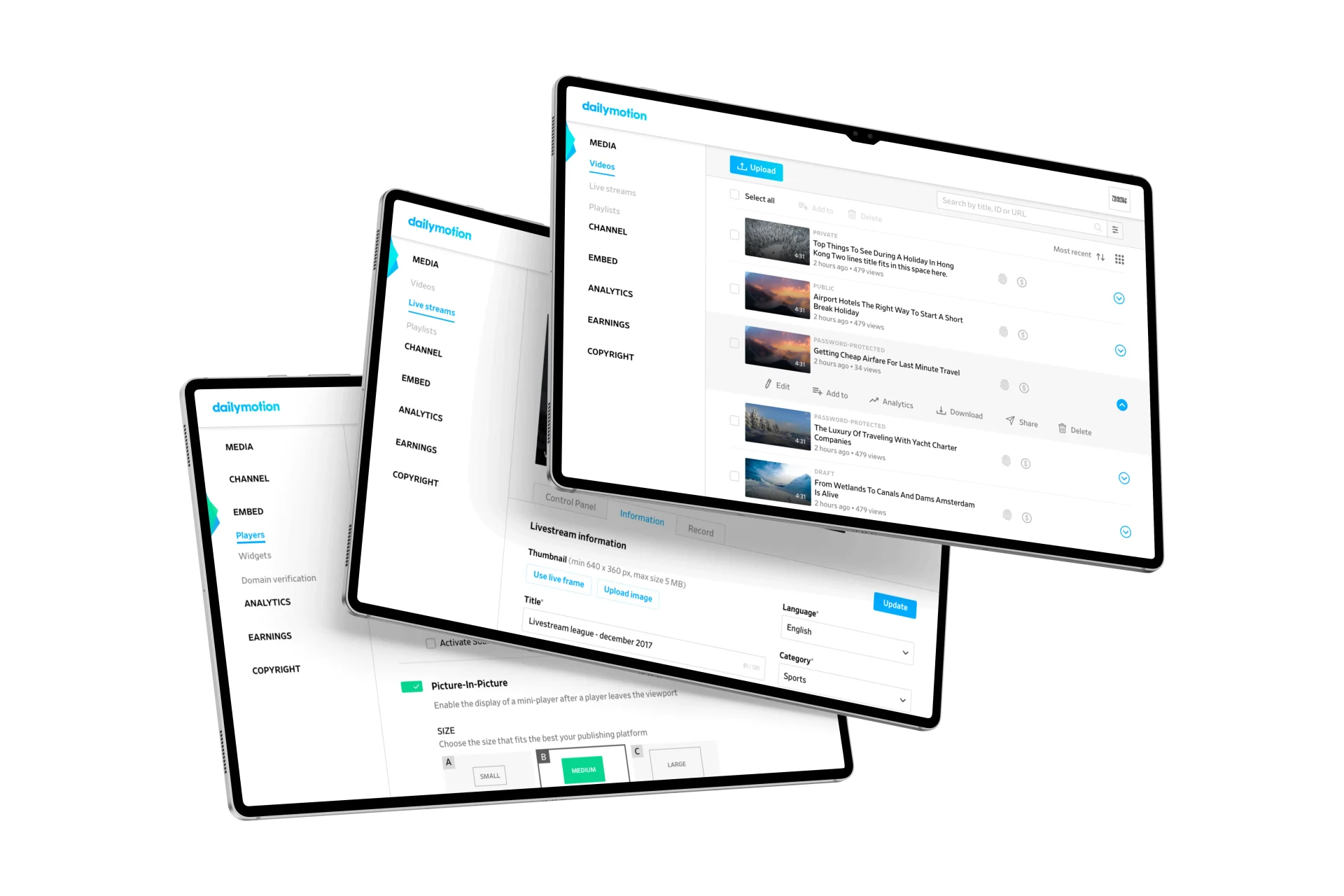
I co-led the redesign of the web and mobile tools Dailymotion offers its media partners to upload, edit and livestream their videos. They serve more than 8,000 direct users across 50 to 100 premium publishers. Upload preparation time dropped by 50%.

Dailymotion was moving from general consumer content to a premium platform for media partners. Leading partners were already on board, but their tools, inherited from a legacy back-office, were heavy and inconsistent, which held back professional use. Thousands of videos were uploaded every day.
Senior Product Designer for the Partner Business Unit, I co-led the full redesign and the UX and UI of the tools, from upload to livestream, in coordination with the teams in Paris, New York and Marseille.
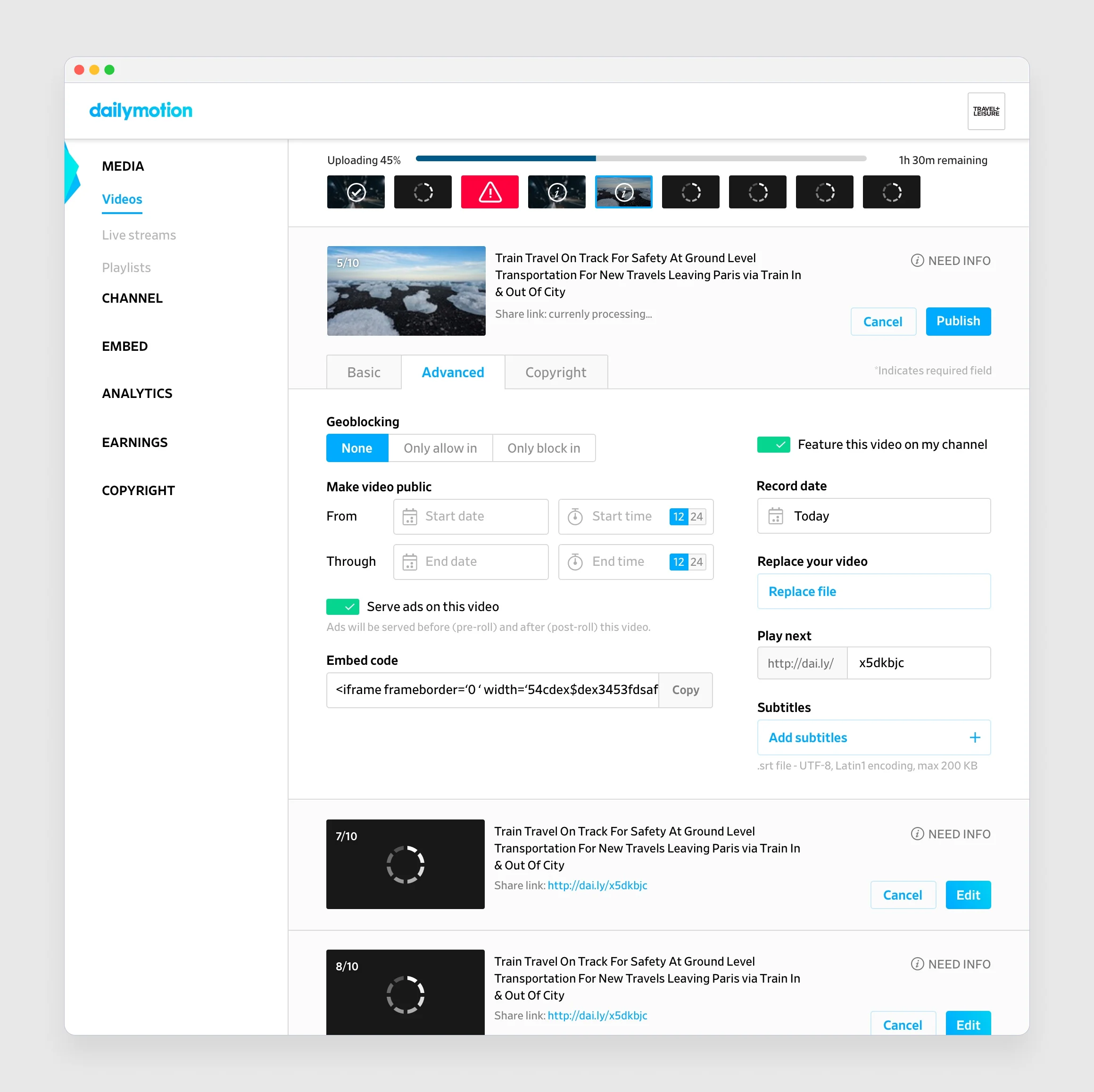
Upload and management
From upload to publication, with batch processing and editing while encoding runs.
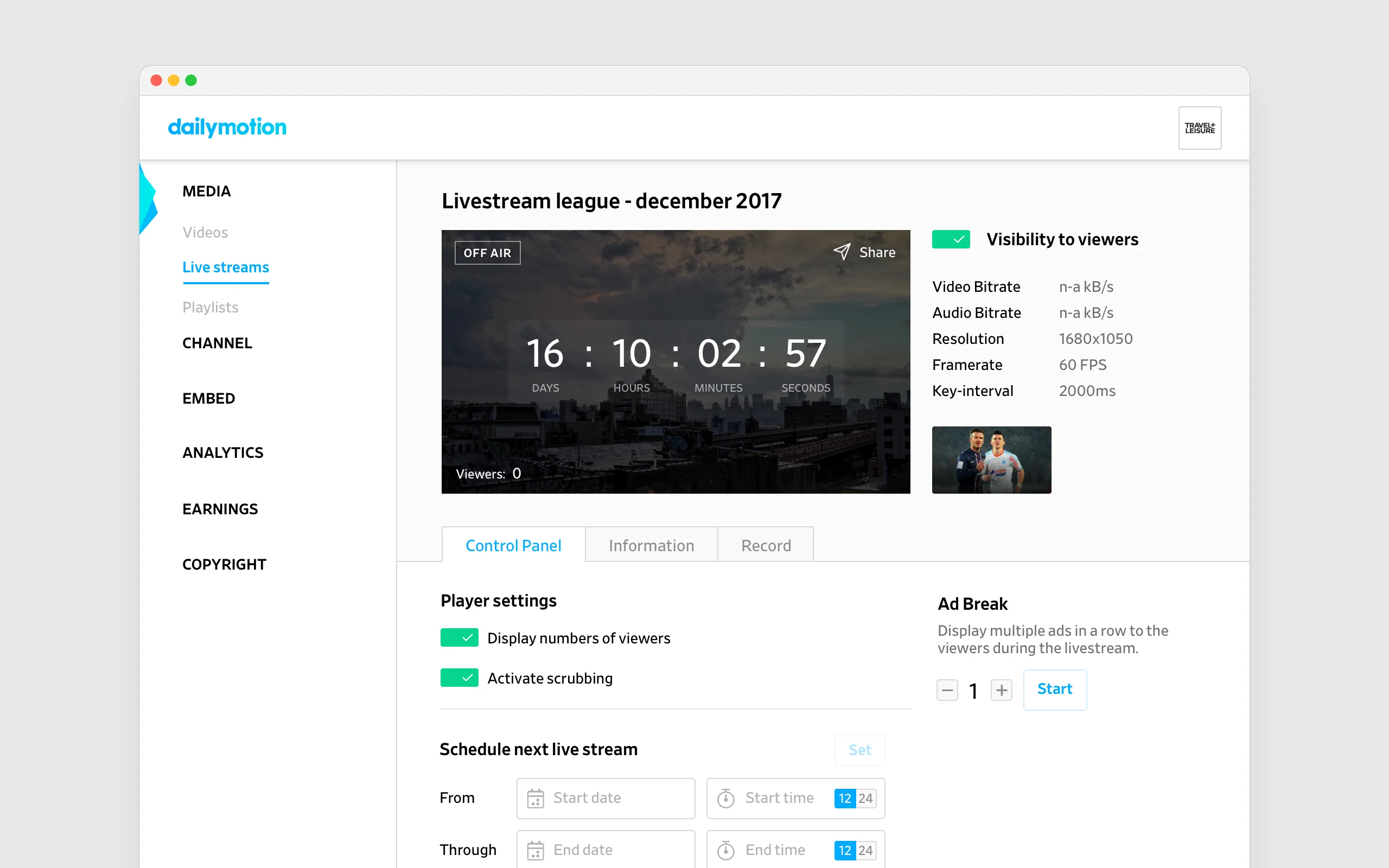
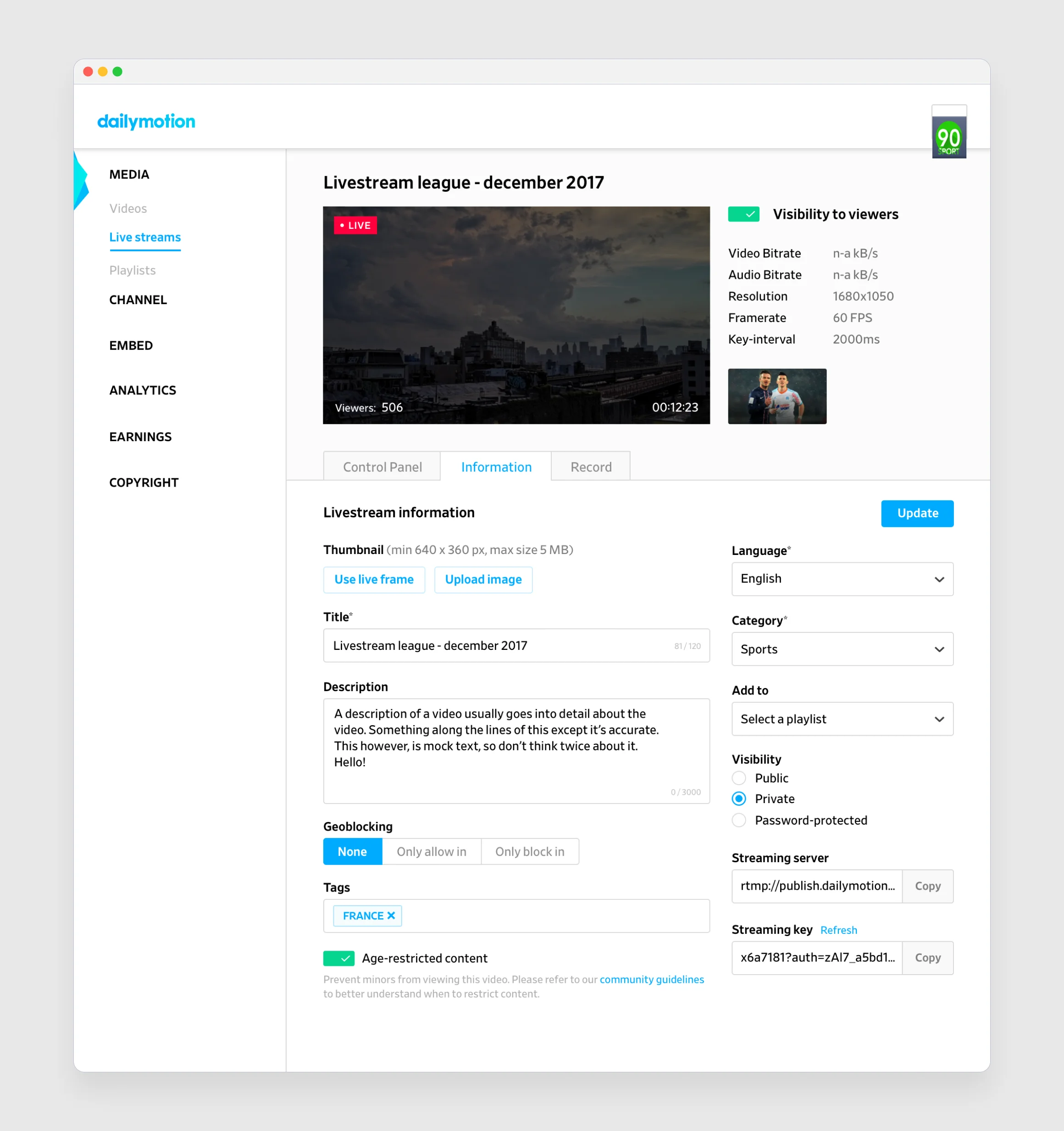
Live console
Real-time monitoring of livestreams, with clear statuses and technical metrics.
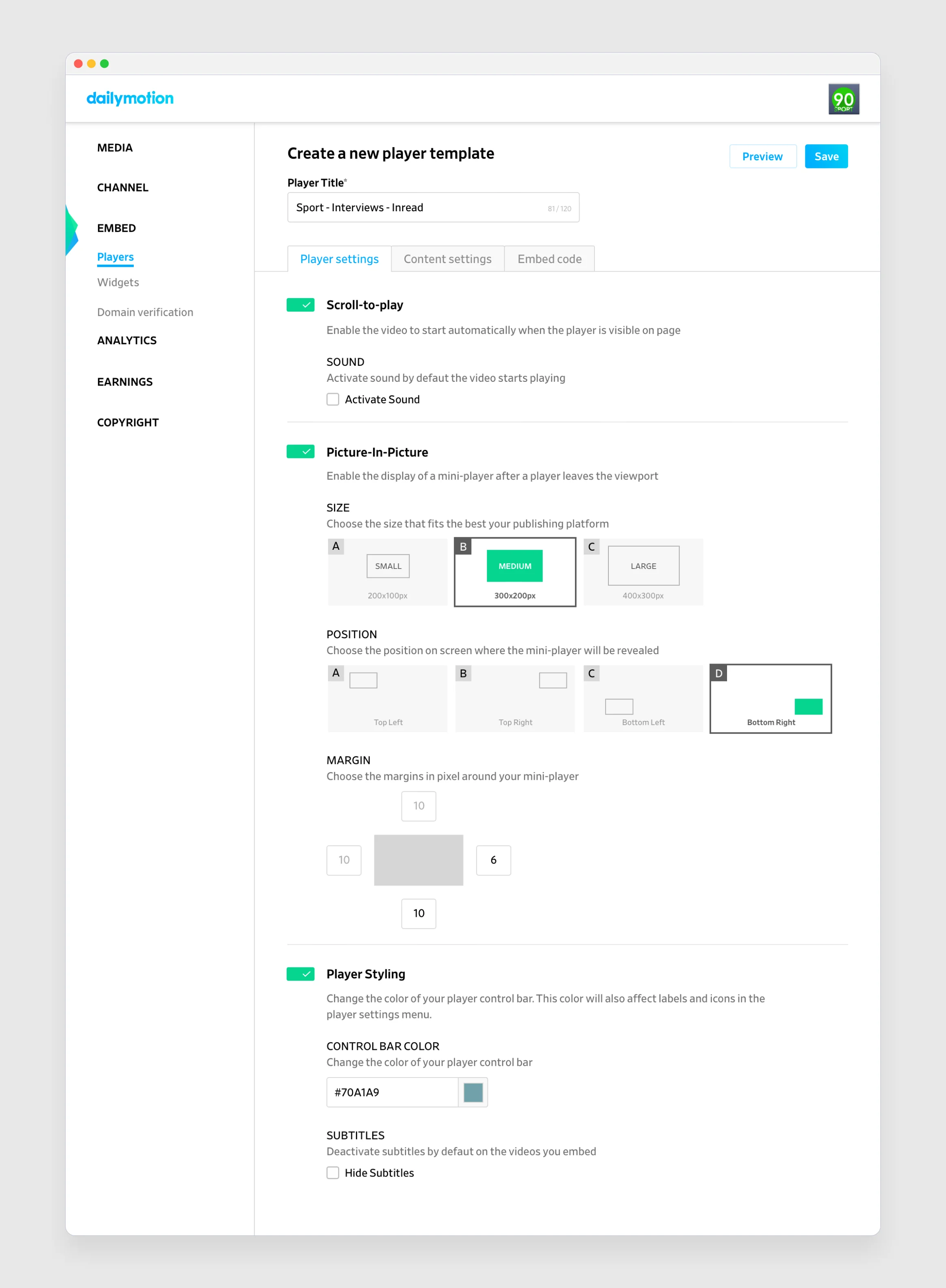
Player manager
Visual customization of embed players and playback behaviors.
Video library
Bulk media management, with status indicators and batch actions.
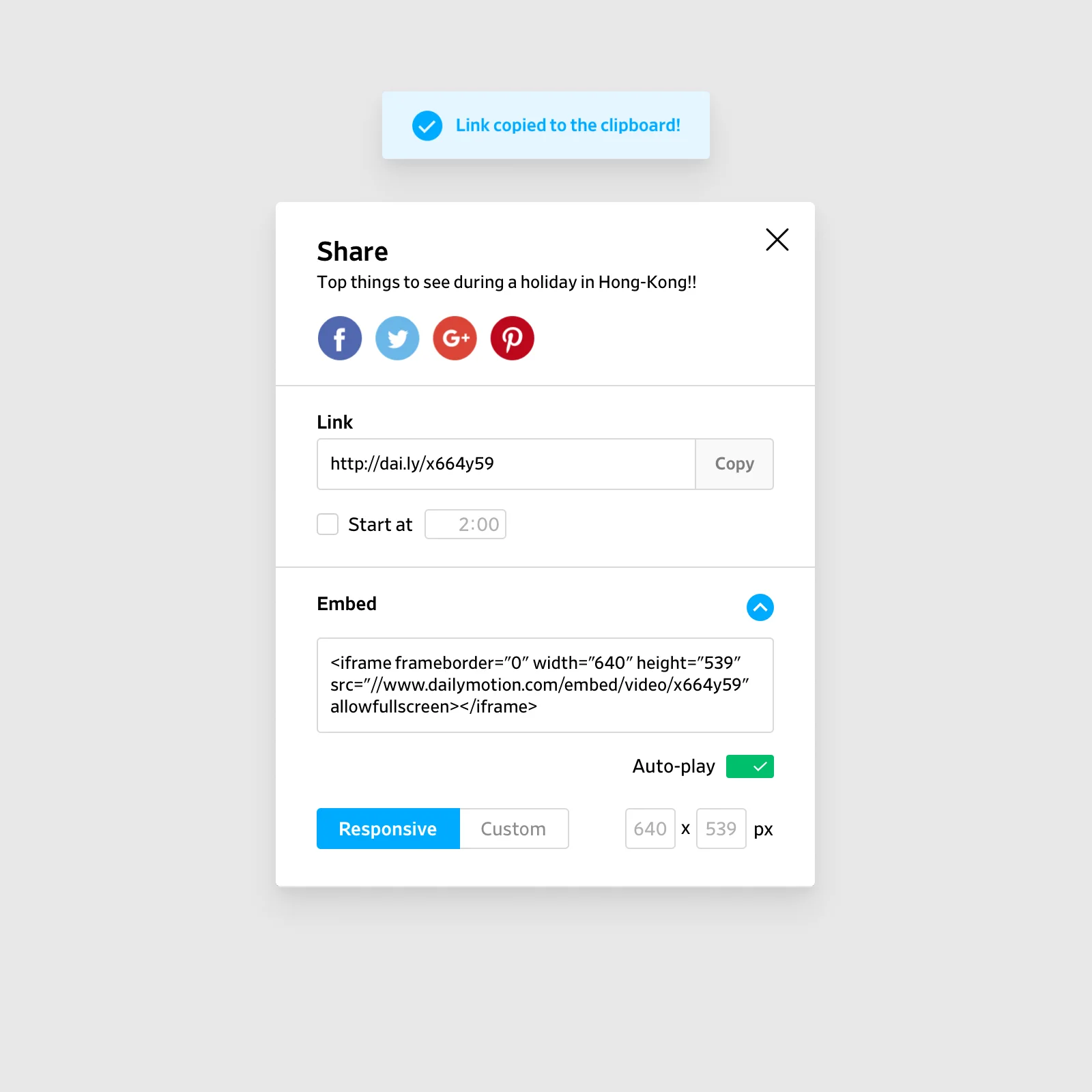
Share and embed
Full embed options, with an automatically generated iframe code.
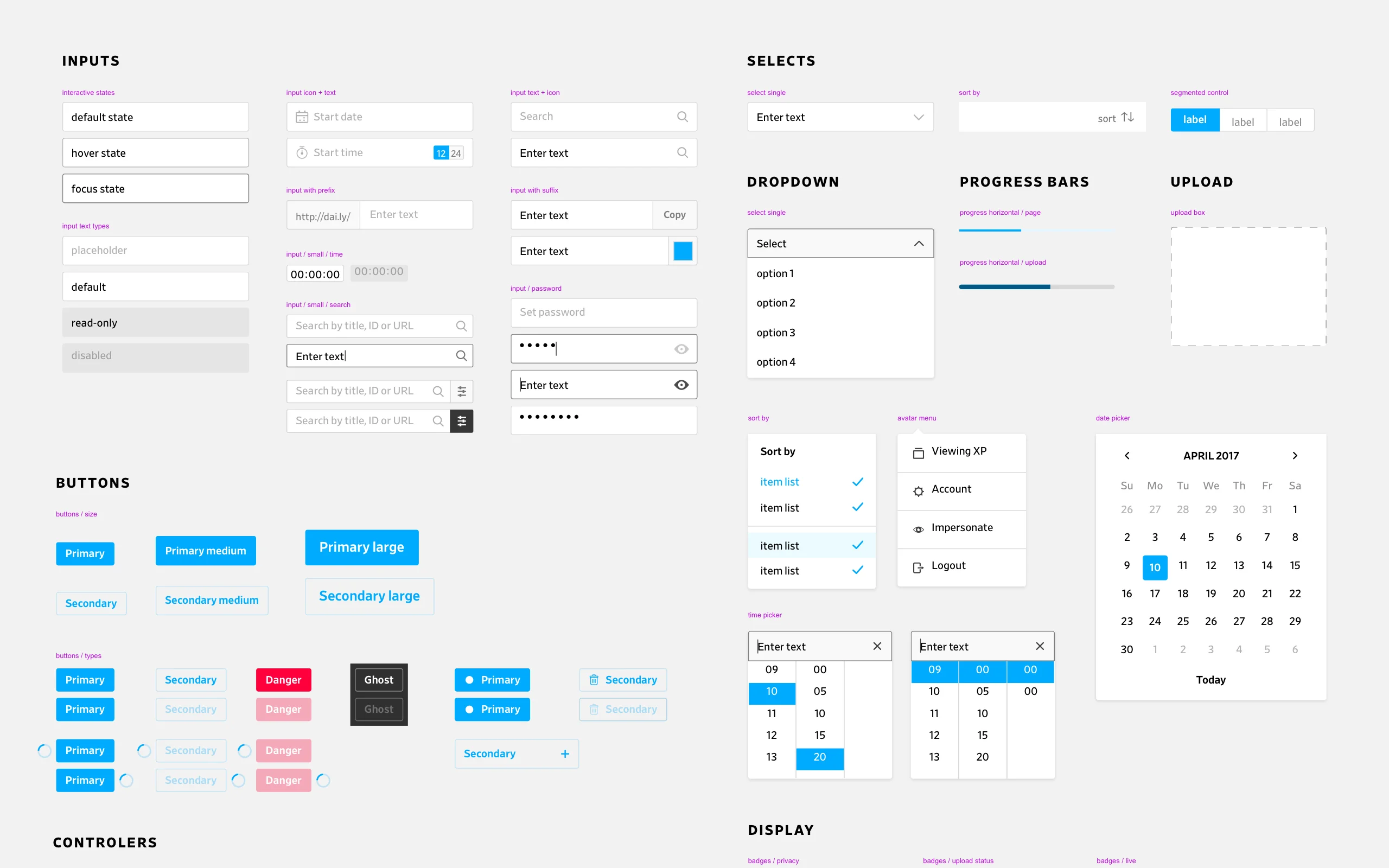
Design system
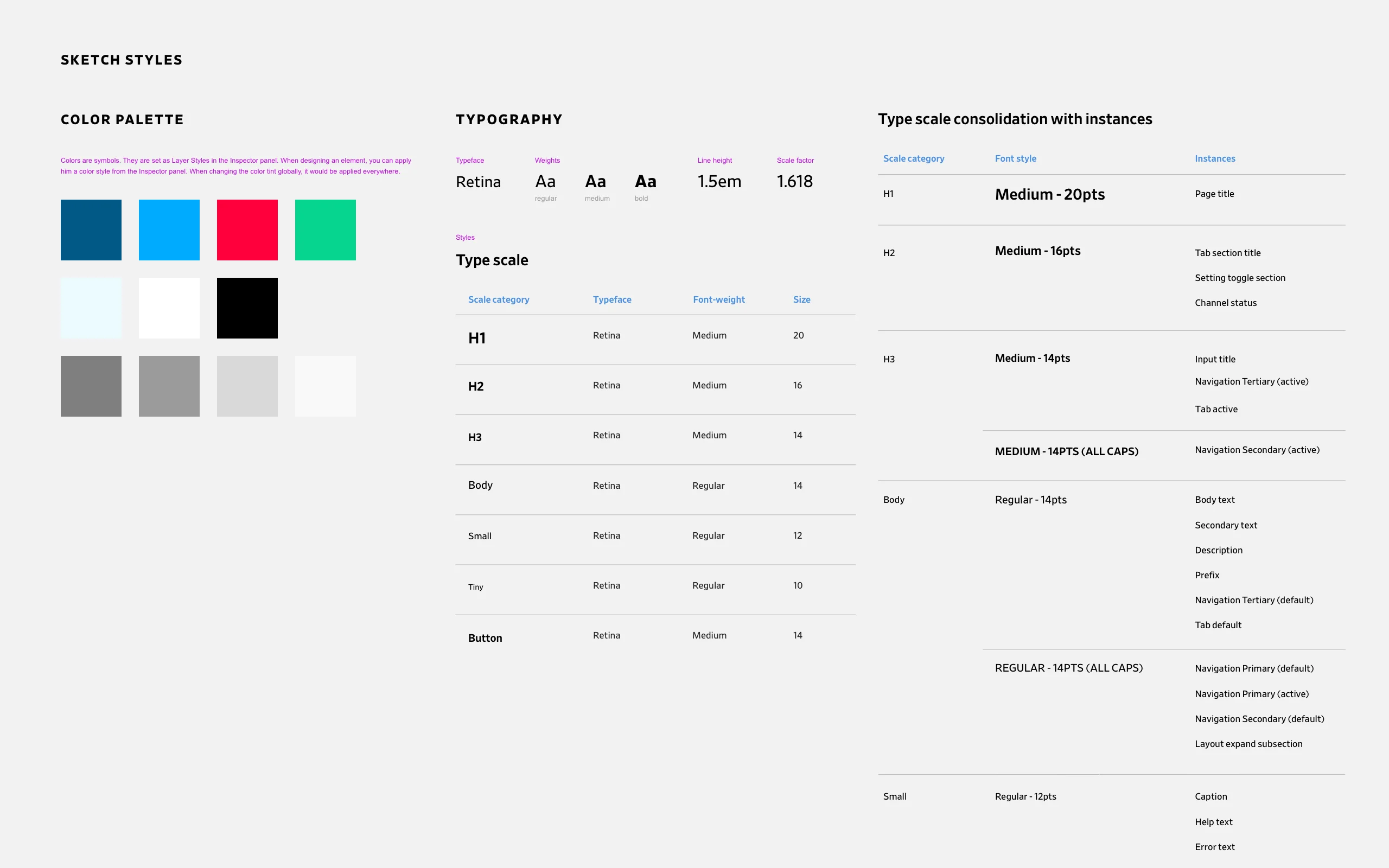
The company’s first Storybook UI kit, designed in Sketch, with 120+ components.
Dailymotion’s partners publish at scale. Each video goes through several encodes, metadata rules, an ad configuration and a distribution schedule, and all of it has to stay in sync. The legacy back-office no longer kept up with that pace and changed logic from one screen to the next. The challenge was to replace it with a reliable control center for media operators, on a base that could grow with the product suite.
The Partner Space is organized around the three workflows partners use every day. Each module works on its own and shares the patterns of the design system.
Partners publish at industrial scale. The new flow processes files in parallel, shows progress and errors in real time, and lets editors change the title, the geoblocking or the schedule while encoding runs. The editor prepares a video without waiting for processing to end. Preparation time dropped by 50%.

01 / 03
During a broadcast, an operator has to react fast to a change in encoding or audience. The console is organized in three panels, Control, Information and Record, which follow how a broadcast is thought through. Each status change (Ready, On Air, Recording, Completed) is animated to confirm that the command was received. Metrics update in place, without distracting motion.
01 / 02
Videos have to play the same way on every partner site, and non-technical users have to configure their own players. The interface starts from a simple list and opens the detailed tabs only when needed. Creating a player follows a guided flow in three steps: appearance, content, then embed code, without a modal that cuts the context.
01 / 02
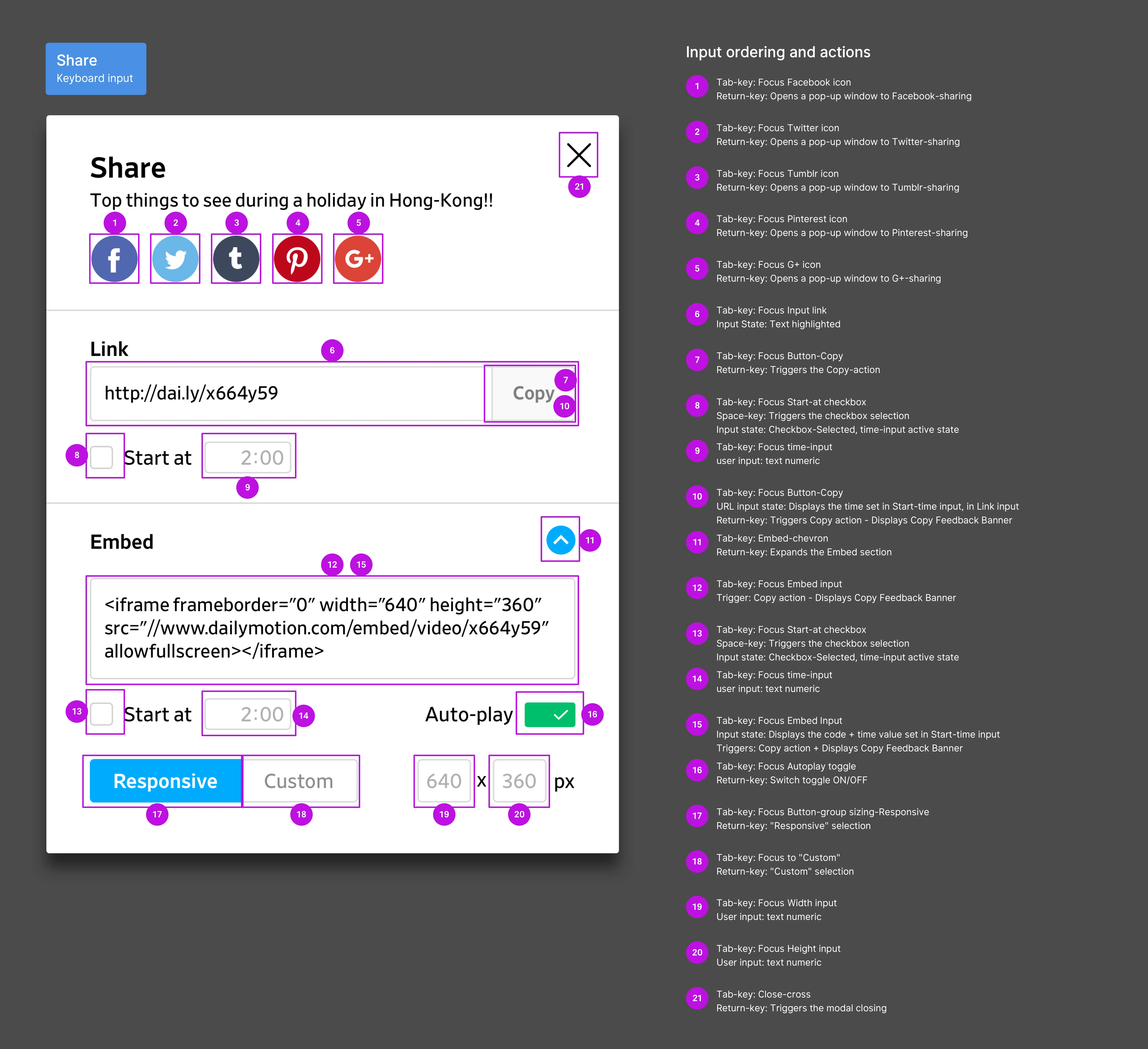
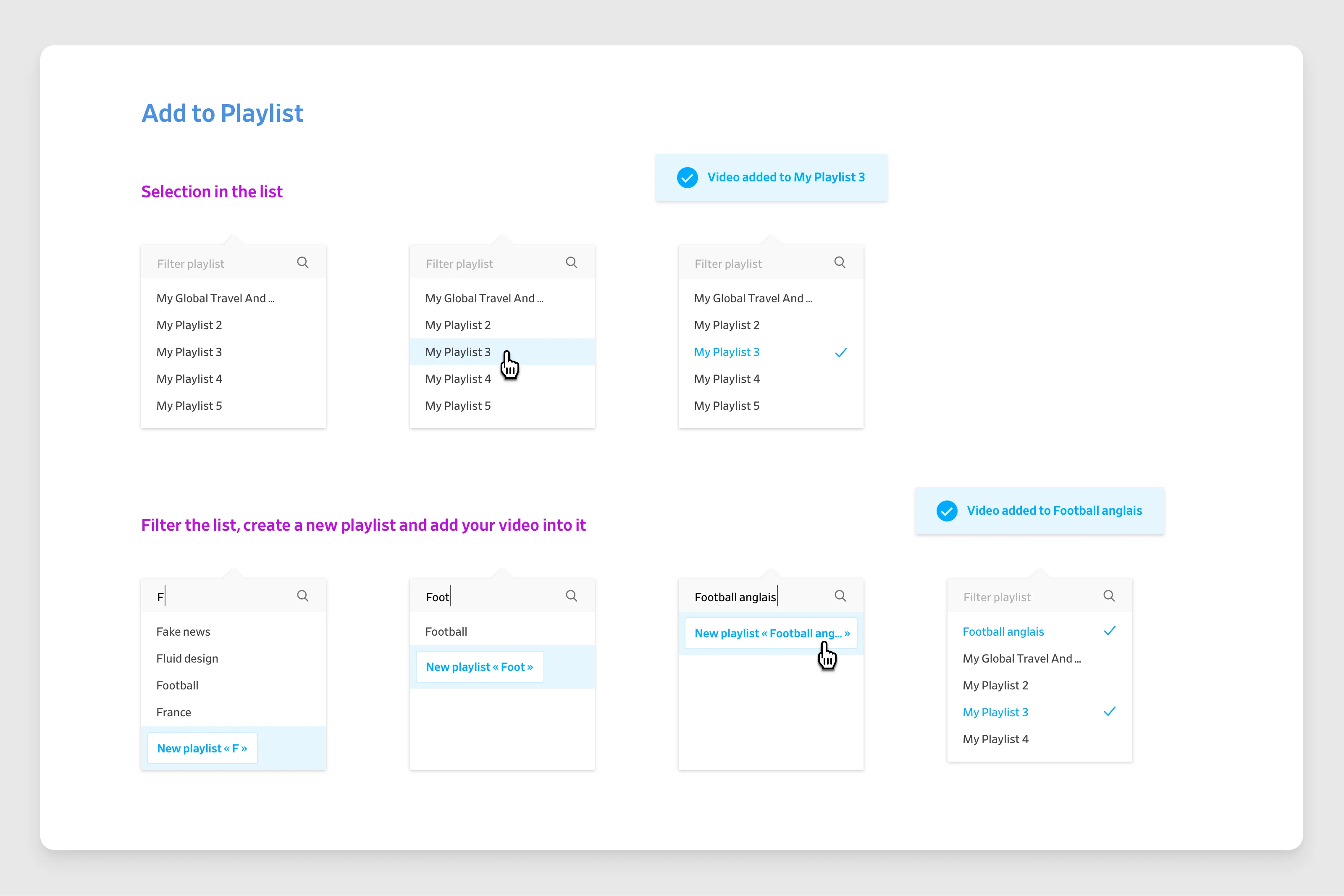
So that what shipped matched what had been designed, I prototyped the interactions with animation and wrote annotated specifications for the developers: keyboard entry of the start time, adding to a playlist, the share window. Sharing stays light for a quick send, and the embed options open on demand.
01 / 03
To keep a growing product suite consistent, I led the creation of the company’s first Storybook UI kit, designed in Sketch and integrated in agile with the developers. It gathers more than 120 components with their variants and states, and gives the partner tools a common base.
01 / 02
The three workflows now follow the same rules: complexity that opens progressively, visible feedback after every action and shared components. Media partners were able to adopt the new tools quickly, and the teams have a common base for what comes next.